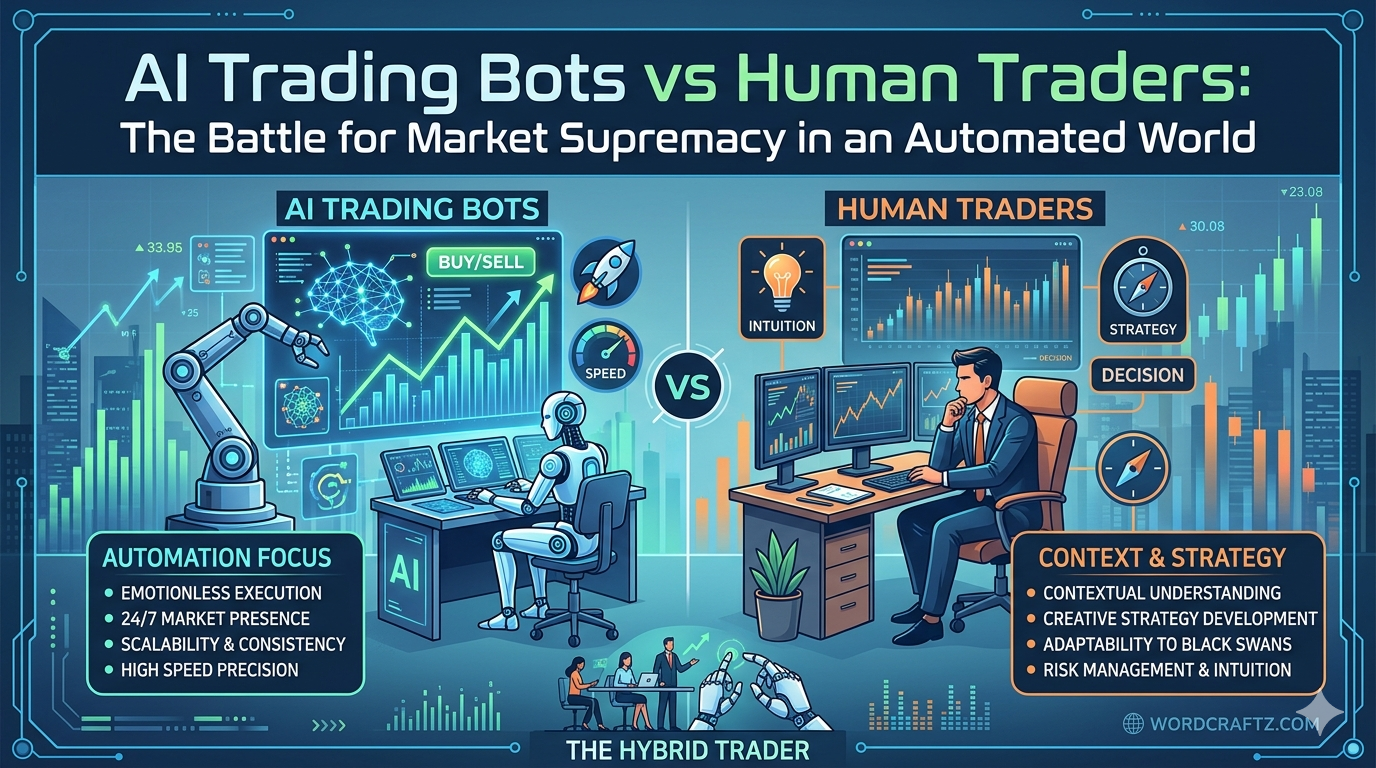
The financial landscape has shifted from the bustling floors of Wall Street to the silent, climate-controlled server rooms of global data centers. In this new era, the primary struggle for market dominance is no longer between competing firms alone, but between biological intuition and silicon speed. As we analyze the state of modern finance, the central theme is automation. The question of who wins, including the role of Ai, is not merely a matter of profit but a matter of efficiency, psychological endurance, and the ability to process infinite streams of data in real time.
The Architecture of Automation
The rise of artificial intelligence in trading, particularly the use of Ai, is rooted in the sheer volume of data produced every second. For a human trader to stay informed, they must read news reports, monitor social feeds, analyze technical charts, and keep an eye on macroeconomic indicators like interest rates or employment data. This creates a cognitive bottleneck.
Automation removes this bottleneck. AI trading bots, leveraging Ai, are built on sophisticated architectures that allow for multi-threaded processing. While a human is focusing on one currency pair, a bot can monitor five hundred. This scale is the first major win for automation. By leveraging machine learning, these bots do not just follow static rules; they evolve. They identify patterns in price action that are invisible to the naked eye, such as microscopic correlations between unrelated asset classes.
The Psychological Advantage of Silicon
Perhaps the greatest weakness of the human trader is the limbic system. The human brain is evolved for survival, not for the high stakes environment of a volatile market. When a trade goes against a human, the fight or flight response triggers. This often leads to two catastrophic errors: revenge trading or freezing.
Revenge trading occurs when a trader attempts to win back losses by taking higher risks, usually resulting in a total account wipeout. Freezing happens when a trader refuses to cut a loss, hoping against all logic that the market will turn around.
An automated system is immune to these biological impulses. A bot feels no pain when a stop loss is hit. It experiences no euphoria after a win. It simply moves to the next calculation. This mechanical consistency ensures that the trading plan is executed with 100% fidelity. For a business owner, this level of consistency is the gold standard. Whether you are managing a portfolio or learning how to write product description content that maintains a consistent brand voice, automation provides a level of reliability that human effort alone struggles to match.
Speed and the High Frequency Frontier
In the world of High Frequency Trading, the winner is determined by microseconds. Human reaction time is approximately 200 to 300 milliseconds. In that window of time, an AI bot could have executed thousands of trades.
This speed allows bots to exploit arbitrage opportunities—the tiny price differences of the same asset across different exchanges. By the time a human sees the opportunity and moves their mouse to click “buy,” the bot has already bought the asset on one exchange and sold it on another, capturing a risk-free profit. While retail traders might not operate at the microsecond level, the presence of these bots means the market is more efficient, leaving less “easy money” for the manual trader to pick up.
The Human Edge: Context, Nuance, and Black Swans
If bots are so superior, why do human traders still exist? The answer lies in contextual intelligence. AI is historically grounded. It learns from what has happened in the past to predict what might happen in the future. However, the market is frequently hit by “Black Swan” events—unprecedented occurrences like a sudden geopolitical shift or a global health crisis.
During these moments, AI models can fail because they have no historical data to reference. A human trader can look at the news, understand the gravity of a world event, and decide to move to cash or change their strategy entirely. Humans understand the “why” behind a move, whereas a bot only understands the “what.”
This human ability to adapt to new paradigms is irreplaceable. It is the same reason why, despite the rise of AI writing tools, human creativity is still the driving force behind effective communication. For instance, when exploring multilingual content benefits globally, a bot can translate words, but a human understands the cultural nuances required to truly connect with an audience. In trading, as in content, the human provides the soul and the strategy, while the machine provides the scale.
The Hidden Costs of Automation
It is a misconception that AI trading is “set and forget” income. Developing a robust bot requires significant capital, technical expertise, and constant maintenance. Markets are dynamic; a strategy that works today might be obsolete by next month because other bots have learned it and began trading against it. This is known as alpha decay.
Human traders who use automation must become quant” strategists. They spend their time backtesting data, optimizing parameters, and ensuring the bot’s code is secure from bugs or flash crashes. The win for automation here is that it shifts the human’s workload from manual labor to high level oversight.
Data Security and Ethical Considerations
As we move toward a fully automated market, concerns regarding data privacy and security become paramount. If a trading bot’s API keys are compromised, an account can be drained in seconds. This highlights the importance of robust digital hygiene.
For users in the United States, privacy laws are becoming increasingly strict to protect consumers from the unauthorized sale of their data. This is why websites must be transparent about their data practices. Providing a clear Do Not Sell link is not just a legal hurdle; it is a way to build a relationship with your users based on trust. When users feel secure, they are more likely to engage with your platform, whether they are there for financial advice or creative writing services.
Institutional vs. Retail: Closing the Gap
For decades, the most powerful automation was reserved for billion dollar hedge funds. Today, the democratization of data has allowed retail traders to access similar tools. Python libraries, cloud computing, and low cost trading APIs have leveled the playing field.
The retail trader who wins today is the one who adopts a professional mindset. They use bots to scan the markets and manage risk while they spend their time studying the broader economic cycles. They treat their trading like a business. Just as a professional website at WordCraftz uses optimized content to reach a global audience, a professional trader uses optimized code to reach global markets.
The Convergence: The Hybrid Trader
The ultimate winner in today’s market is the hybrid trader. This individual recognizes that the bot is a tool, not a replacement.
- The Bot handles the Execution: It enters and exits trades with precision, manages stop losses, and monitors the market 24/7.
- The Human handles the Hypothesis: They decide which markets to trade, how much total risk to take, and when to turn the bot off during periods of extreme, illogical volatility.
This partnership allows for a lifestyle that manual trading cannot provide. It frees the individual from the screen glow of watching charts all day, allowing them to focus on other creative or professional pursuits.
External Authority and Compliance
To succeed in this space, one must stay informed through verified sources. Understanding the legal and technical framework is vital.
- The Financial Industry Regulatory Authority (FINRA) provides essential guidelines on trading integrity and protecting yourself from fraudulent automated schemes.
- The Commodity Futures Trading Commission (CFTC) offers resources on how automated systems impact the futures and commodities markets.
- The World Economic Forum often publishes reports on how AI is reshaping global financial stability and what that means for the average investor.
Conclusion: The Future belongs to the Automated
The debate of AI vs. Human is reaching a conclusion: Automation is the winner of the process, but the human is the winner of the purpose.
If you are looking to dominate in today’s market or any digital field you must embrace the tools of the future. Whether you are building a trading empire or expanding your digital footprint through WordCraftz, the secret to success is the same. Use the speed and precision of technology to handle the repetitive tasks, and save your human brilliance for the decisions that truly matter.
The market does not care about your effort; it only cares about results. By automating your path, you ensure that your results are consistent, scalable, and built to last in a world that never stops moving. Visit our resources at WordCraftz to learn more about optimizing your digital world, from multilingual content benefits to the art of the product description. The future is automated make sure you are the one holding the controls.
Discover more from Wordcraftz
Subscribe to get the latest posts sent to your email.
