
B2B Website Copywriting: Why Buyers Leave Before They Book
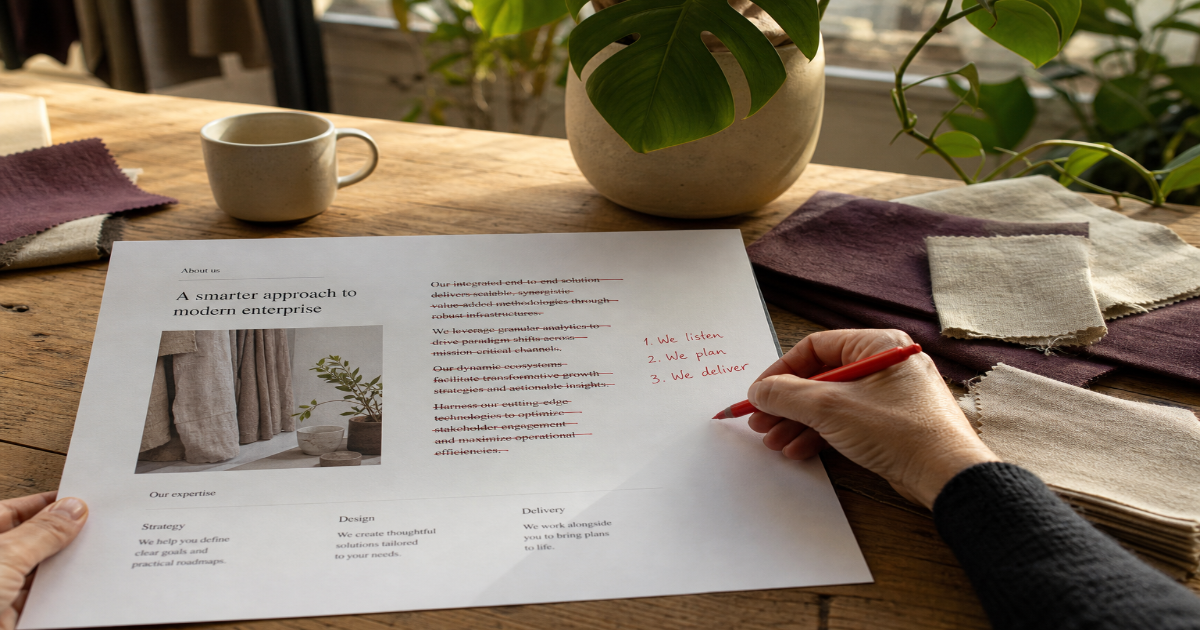
A buyer lands on your homepage, reads the first screen, and clicks back to the search results. That exit rarely means your offer is wrong. It means your B2B website copywriting never made the offer clear enough to act on.
Teams spend months refining positioning decks and pricing models. Then they hand the page to whoever has time and describe the business from the inside, using language only coworkers understand. The visitor gets a wall of category terms and no reason to stay.
This article breaks down why B2B website copywriting fails before the booking ever happens. You’ll learn to spot the exact sentences that push buyers away and rewrite the first screen so a stranger knows what you do, who it’s for, and what changes for them.
What B2B Website Copywriting Actually Has to Do
B2B website copywriting is the work of making a complex business legible to a buyer who has no context and no patience. It is not the same as describing the company accurately. Accuracy is the floor. Legibility is the job.
Teams confuse the two constantly. A page can be factually flawless and still tell a stranger nothing about whether they belong there.
The first screen owes the visitor three answers in plain language. What does this business do, who is it for, and what changes for the buyer who says yes? Skip any one and the visitor has to work to find it. Buyers do not work. They leave.
Consider a mid-market logistics platform. Its homepage leads with “end-to-end supply chain orchestration for the modern enterprise.” Every word is true and none of it lands. Rewritten as “we move freight for manufacturers who can’t afford a late shipment,” the same business becomes legible in a single read.
That rewrite is not dumbing anything down. It is translating what the business knows into what the visitor can grasp in a few seconds. Accuracy without clarity reads as noise. The buyer’s brain files it under “not for me” and moves on.
The distinction matters because it changes what you edit. You stop asking whether the page is correct and start asking whether a stranger could repeat your offer back to you after one screen. If they can’t, the page has failed, no matter how polished the prose.
The Understanding Gap That Sends Buyers Away
Price objections are the excuse buyers give on the call. The real cause happens earlier, when a visitor cannot decode what the page is selling. That gap between what your team knows and what a stranger can grasp is where B2B website copywriting either earns the booking or loses it.
Internal teams carry years of context into every sentence. They know the acronyms, the category shorthand, the reason the product exists. A first-time visitor carries none of it, and the page never translates. Writing from inside the business is the most reliable way to write past the buyer.
Watch what a visitor does on arrival. They scan for one sentence that tells them what this is and whether it applies to them. What they find is “unified orchestration layer” and “enterprise-grade infrastructure.” Decoding that takes effort they did not budget for, so they leave. The Stanford web credibility research project studies how quickly visitors form these judgments.
Closing the gap is not a rewrite exercise. It starts with aligning every message to the audience and the business goal before a sentence gets drafted. Wordcraftz runs strategic messaging work this way, because a page that builds trust and converts begins with that alignment, not better adjectives.
The uncomfortable part: your team cannot see the gap from where it sits. Someone outside the business has to read the first screen cold and say what it means. Until then, the page keeps reading as noise to everyone except the people who wrote it.
Why Credibility Fails Before the Copy Is Read
Trust gets decided in the half-second before anyone reads your headline. A visitor judges the page as a whole, then decides whether the words deserve attention. Weak credibility signals sink good B2B website copywriting before a single sentence lands. Jakob Nielsen identified four credibility factors in web design that shape that instant judgment. Each one operates on the visitor before the argument begins.
- Design quality that reads as current. A layout stuck in an older era signals a company that stopped investing in itself. Visitors read dated design as dated operations.
- Up-front disclosure of who you are. Hiding your company name, location, or pricing behind three clicks reads as evasion. Buyers trust pages that answer before being asked.
- Comprehensive and current information. A case study dated three years back tells the visitor the work may have stalled. Stale content quietly argues against you.
- Connection to outside proof. Logos, press mentions, and third-party validation carry weight your own claims cannot. Self-praise without external backing reads as marketing noise.
The trap is treating copy and page experience as separate projects. A copywriter hands over strong sentences, a designer polishes the layout, and nobody checks whether the two reinforce each other. They either build trust together or undermine each other in the same scroll. Audit your page for these signals before rewriting a single line. Fix what breaks trust first, then let the copy do its work on a foundation that holds.
The Misconception: Buyers Want More Detail
Buyers do not abandon B2B website copywriting because the page withheld something. They leave because the page buried the answer under every capability the company could list. Two page models explain the difference: the spec-dump page and the decision page.
The spec-dump page treats completeness as credibility. It inventories integrations, compliance badges, deployment options, and edge-case features in one long scroll. Buyers who already know what they need can find it. Everyone else has to assemble the argument themselves, and few will.
The decision page answers the buyer’s actual question at each stage. It says who the product is for, what changes after adoption, and what the next step costs in effort. Detail belongs one click deeper, not on the first screen. The top of the page owes the visitor a reason to keep reading, not a manual.
Google’s own guidance on page experience ranking signals points the same direction. Pages that load cleanly and read cleanly get rewarded. Clutter costs you twice, in comprehension and in search visibility.
Wordcraftz builds pages through growth-focused content work, aimed at visibility and conversion rather than volume. That distinction matters when SEO writing and sales copy get muddled into one undifferentiated wall of text.
The decision page wins whenever the visitor arrives without full context, which describes nearly every first-time B2B visitor. Reserve the spec dump for the technical evaluation page, one click deeper, where the reader has already decided you’re worth the effort.
How B2B Website Copywriting Earns the Booking
A booking is the last step in a sequence, not a single moment of persuasion. Skip any link in that chain and the visitor stalls, then leaves. Four moves carry a stranger from landing to calendar.
Step 1. Name the buyer and the problem in the first screen. A visitor needs to recognize themselves in your opening line within seconds. Skip this and they assume the page is for someone else, then hit back before reading further.
Step 2. State the outcome in the buyer’s language, not your internal vocabulary. Translate what changes for them into the words they’d use with a colleague. Without that translation, the value stays invisible even when the product is strong.
Step 3. Answer the objection that stops the booking before it reaches a sales call. Pricing, integration risk, and switching cost are the usual blockers. Leave them unaddressed and the visitor assumes the worst, because silence reads as a problem.
Step 4. Make the next step specific and low-risk. “Book a 20-minute call” beats “Get in touch” every time. Pair it with high-converting CTA button copy that names the outcome, and the click feels like a decision rather than a leap.
Page speed belongs in this sequence too. Core Web Vitals measure real-world loading and interactivity, and a slow first screen kills the recognition you just built.
Complete all four and the page does the qualifying a salesperson used to do. That is the outcome worth designing for, and the one Wordcraftz builds toward on every conversion page.
Where Blog Content Fits in the Buying Path
A blog post and a sales page do different jobs. The blog carries the long answer. The page carries the decision.
The blog is where the full answer lives, so the sales page can stay short
Complex questions deserve a full treatment, and a landing page is the wrong place to give it. A pricing page that tries to explain your integration architecture will lose the visitor halfway down. Let the blog hold the deep answer, then link to it from the page with one line.
A post that ranks is not a post that prepares a buyer to book
Ranking rewards coverage of a query. Booking rewards a reader who now understands their own problem well enough to act. A post optimized only for search ends with a definition. A post built for the buying path ends with a named next step, and that step points at the decision page.
Blog copy surfaces the exact language buyers use
Search queries and comment threads hand you the phrasing your buyers actually type. That phrasing belongs in your headlines, not in a brand workshop deck. Teams running Google’s page experience guidance already watch how real visitors behave on each post. Read the queries behind the posts that earn traffic and you’ll find the words for your homepage. This is the quiet feedback loop inside good SEO content marketing.
A blog that never links back wastes the traffic it earns
Traffic that lands on a post and leaves without seeing the decision page is a cost, not a win. Wordcraftz builds SEO content writing around that handoff, connecting search visibility to the pages that actually convert. Every post needs one deliberate path back to the page where the buyer books.
Is B2B Business Still Worth It in 2026?
Yes, and the reason has changed. Reach used to be the moat. A company that owned the trade show, the sales team, and the industry publication won by being everywhere first. That advantage has collapsed.
Buyers now do the research alone, long before a rep gets a calendar invite. A procurement lead at a mid-market manufacturer will read your pricing page, your case studies, and two competitor sites in a single sitting. The website now carries the selling load a salesperson once carried in the room.
That shift punishes the longest feature list. A page that lists every capability, every certification, every integration reads as work. The buyer has to translate it into a decision, and translation is effort. Effort is where interest dies.
The businesses that win make the decision easy. They name the buyer, state the outcome, and answer the objection before it forms. That is what separates copywriting strategies that convert from copy that merely describes a product.
Worth the investment? More than it used to be. When a page has to do the work a rep once did, weak copy costs you a deal you never knew you lost.
E-commerce teams learned this the hard way. Baymard’s cart abandonment research tracks how often buyers walk away at the final step, and the pattern holds in B2B bookings too. The visitor was interested. The page lost them.
So the question is not whether B2B is still good. It is whether your page can close a buyer who arrives alone, skeptical, and comparing you against two tabs. Most pages cannot, and the fix starts in the sentences nobody has audited.
Fix the Page Buyers Leave Before They Book
Clarity is a decision, not a talent. The businesses that win B2B website copywriting treat the first screen as a translation job, turning internal knowledge into language a stranger can absorb in seconds.
Leave that screen as it is and the cost compounds quietly. Every visitor who bounces takes a booking with them, and the sales team never learns the page was the reason.
Read your own first screen as a stranger would. Ask three questions: does it say what you do, who it is for, and what changes for the buyer? If any answer is missing, rewrite that sentence today.
Wordcraftz crafts website content that makes your offer clear so buyers stay and act. Visit Wordcraftz to get your first screen rewritten.
FAQ
B2B Website Copywriting Questions Buyers and Marketers Ask
Why do B2B website visitors leave without booking?
Visitors leave because the first screen never told them what the business does, who it serves, and what changes for them, so decoding the page costs more effort than clicking back. The exit usually happens before a single feature is read, which is why rewriting the opening screen fixes more lost bookings than adding detail further down.
What is the 80/20 rule in copywriting?
The 80/20 rule holds that a small share of the words on a page does most of the selling, so effort belongs on the headline, the opening screen, and the call to action. Trim the middle of a draft and the strongest sentences usually survive untouched, which tells you where the real persuasion was hiding.
Is copywriting still worth it in 2026?
Copywriting is worth more now, because buyers research the site before they ever speak to a salesperson, so the page has to carry the argument alone. A clear page keeps working after the ad budget stops, while a vague one quietly loses the visitors the marketing team paid to attract.
Is B2B business still good in 2026?
B2B remains a strong business, but the advantage has shifted from reach to clarity, since buyers now compare options without a rep in the room. Companies that win are the ones whose pages make the decision easy, not the ones with the longest capability list.
What makes B2B website copywriting different from consumer copywriting?
B2B website copywriting must address multiple stakeholders, longer buying cycles, and higher perceived risk. Unlike impulse consumer purchases, B2B copy focuses on economic impact, risk mitigation, and operational clarity so buyers can justify the decision to a committee.