
How Content Freshness Affects AI Citations in 2026
ⓘ TL;DR
- Content freshness in 2026 is not a Google ranking factor. It is the prerequisite for being cited by AI systems at all. Stale pages do not rank lower, they become invisible.
- Semantic drift is the real penalty. As language and facts evolve, old vector embeddings drift away from current query vectors, removing pages from the LLM citation pool entirely.
- Google’s Query Deserves Freshness (QDF) signal activates for time-sensitive queries. AI models apply the same logic, weighting sources by recency for fast-moving topics like finance, tech, and regulation.
- Not all content decays equally. Statistics pages, industry guides, product pages, and news content need aggressive refresh cycles. Evergreen foundational content can hold longer, but never forever.
- Changing the publish date is not a refresh. AI citation engines detect the mismatch between metadata and semantic content. Real freshness means substantive updates to facts, examples, and internal references.
The standard advice about content freshness has not caught up to how search works in 2026. Most guides frame it as a ranking factor for Google. That misses the real shift.
Large language models do not rank stale content lower. They stop citing it. Semantic drift pulls old pages away from current query vectors, making them invisible to AI systems. A page published two years ago with unchanged facts is functionally absent from the citation pool.
This article explains how semantic drift erodes AI citations, what the Query Deserves Freshness signal demands, and how to build a refresh strategy that keeps your content cited. Content freshness is the prerequisite for being found at all.
Why AI Systems Penalize Stale Content
The standard advice about content freshness treats it as a Google ranking factor. That framing misses the real penalty now at play. AI citation engines, large language models and vector search systems, penalize stale content in ways Google’s classic algorithm never did. Semantic drift is the mechanism. Language evolves. Facts change. As they do, the vector embeddings of an old page drift away from the current query vectors.
A page written in 2022 about SEO copywriting strategies uses language that no longer maps to how users search in 2026. The result is not a ranking drop. It is invisibility. The AI system simply does not find the page when it assembles a response.
This is not the same as a Google penalty. Google might still index an old page and rank it for long-tail queries. An LLM citation engine retrieves the closest semantic match. If the embeddings have drifted, the page is not retrieved at all. The difference between a ranking drop and total exclusion is the difference between a warning and a door that never opens.
Take a real example. A SaaS company publishing a guide on “API integration best practices” in early 2023 used language that matched the query vectors of that period. By late 2024, the same guide referenced deprecated tools and outdated workflows. The embeddings shifted. The guide stopped appearing in AI-generated answers.
The Query Deserves Freshness Signal Explained
Most content strategies treat all queries the same. Google’s Query Deserves Freshness algorithm does not. QDF detects when a search needs recent results, breaking news, trending topics, rapidly changing fields like finance or health. Ignoring this signal means your content disappears from the SERP exactly when it matters most.
What QDF Actually Detects
QDF is not a blanket freshness boost. It activates only for queries where timeliness is part of the user’s intent. A query about “2026 tax brackets” triggers QDF. A query about “how to file taxes” may not. The algorithm evaluates the query’s temporal context, how recently the topic has changed and how urgently searchers need current information. This is the core of the Query Deserves Freshness concept.
How QDF Interacts with AI Citations
Large language models apply a similar logic. When an LLM retrieves information to answer a query about a fast-moving field, it weights sources by recency. A 2023 article on AI regulation will not be cited for a 2026 question about the same topic. The model detects the temporal mismatch between the source and the query. Stale content does not just rank lower, it becomes invisible to the citation engine.
Identifying QDF-Sensitive Queries for Your Niche
Not every query in your niche triggers QDF. Start by mapping topics with known change cycles, regulatory updates, product releases, industry benchmarks. Then check search results for recency patterns. If the top results for a query are all from the last 30 days, that query is QDF-sensitive.
Wordcraftz helps brands identify which queries in their niche carry this signal and which do not, so refresh efforts target the pages that actually need them. This is a core part of modern SEO best practices.
How the Featured Snippets Freshness Update Changed the Game
The old playbook was simple. Publish once and rank for years.
Then came 2019. Google’s Featured Snippets Freshness update rewrote the rules. The algorithm began prioritizing recently updated content for snippet selection. A five-year-old page with strong domain authority could lose its featured snippet to a six-month-old page with fresher information. This was a structural change in how Google evaluates relevance for the most visible real estate on the results page. The update made clear that ownership was temporary.
AI citation engines operate on the same logic. Large language models pull from the freshest authoritative source available. A page that was the definitive guide in 2020 becomes invisible to an LLM in 2026 if not updated.
The consequence is direct. Freshness is no longer a nice-to-have for snippet visibility. It is a competitive advantage that compounds. A page refreshed quarterly will be cited more often than a page updated once in five years, even if the older page has more backlinks. This is where On Page SEO strategies must evolve beyond keyword placement and into temporal relevance.
Consider how Zapier’s help center handles this. Their guides are refreshed every quarter, because the examples and context do. An LLM citing Zapier’s documentation in 2026 will pull from the version updated last month, not the original from 2018.
That is the standard now. Freshness is a signal of trust. The model does not know the page is old. It knows the page contradicts newer information on the same topic. That contradiction is enough to drop it from the citation pool entirely.
Which Content Types Need Updating Most Often
Not all content decays at the same rate. Some pages lose relevance within weeks while others hold value for years, and the difference determines whether an AI cites your work or ignores it.
The fastest-decaying content types share one trait: they make specific, time-bound claims. A page full of 2022 statistics will never answer a 2026 query correctly, regardless of how well it was written. The same logic applies to content freshness strategies that treat all pages equally.
- Statistics and data pages. Numbers age faster than any other content element. A single outdated figure can make an entire page untrustworthy. LLMs will drop the citation entirely rather than risk propagating a false number.
- Industry guides and how-to articles. Processes change. Software updates. Regulations shift. A guide written three years ago may contain steps that no longer work or tools that no longer exist. AI citation engines detect this mismatch through semantic drift.
- Product and service pages. Offerings evolve constantly. Pricing changes. Features get added or removed. An old product page that describes a discontinued plan will confuse both users and the LLMs that surface it. The page becomes a liability.
- News and trend analysis. Timeliness is the entire value proposition. A trend analysis from last quarter is already obsolete. AI citation engines treat news content as fresh only within a narrow temporal window, typically days or weeks.
Prioritise refresh cycles by decay rate, not by page age. A statistics page from last month needs updating more urgently than a foundational guide from two years ago. Build your content calendar around this hierarchy. An SEO-friendly blog post from 2020 might still rank, but it will not earn AI citations in 2026.
How to Find Outdated Content at Scale
Most content audits fail because they treat every page equally. Finding outdated content at scale requires a system that prioritises by decay signal, not just page age. Without that system, teams waste weeks refreshing pages that never needed it while high-value content rots unseen.
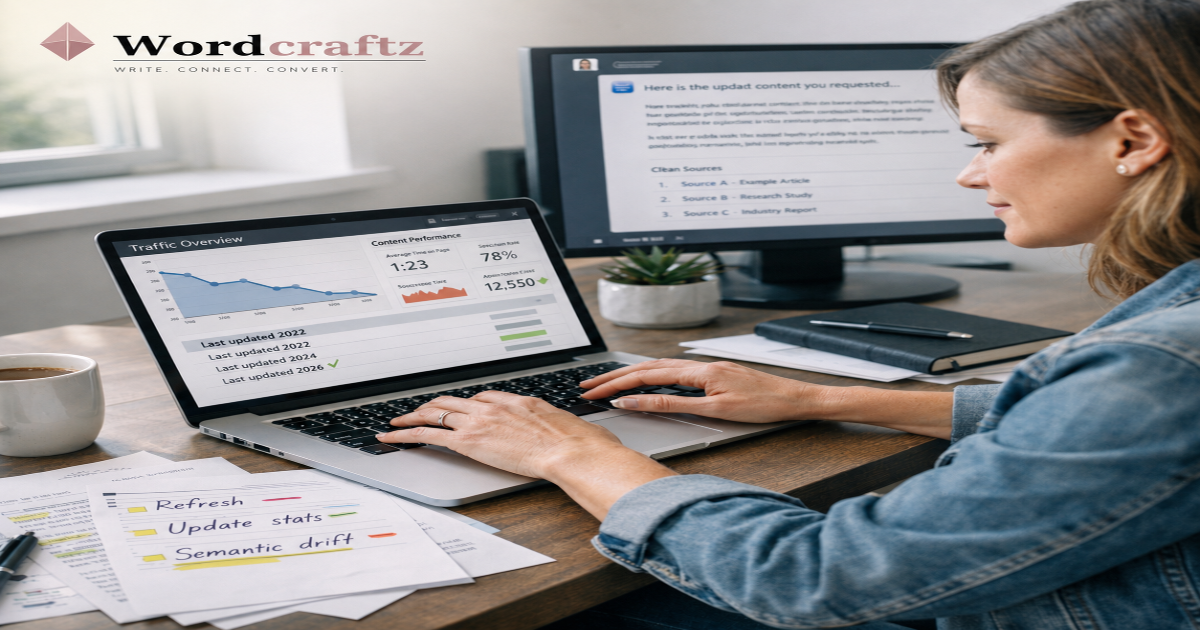
Step 1. Audit your content inventory using analytics to isolate pages with declining traffic. A page that lost 60% of its organic visitors over six months is not having a bad month, it is being ignored by both search engines and AI citation engines. Skip this step and you refresh the wrong pages first.
Step 2. Check publish dates and last-updated dates, flagging anything older than 12 months. But date alone is not enough. A 2023 evergreen guide on content freshness signals may still perform, while a 2024 article on AI tools is already obsolete. The penalty for skipping this step is spending time on pages that still rank.
Step 3. Cross-reference your inventory with AI citation tools to see which pages LLMs cite and which have dropped off entirely. Pages that once appeared in ChatGPT responses but no longer do are prime candidates for a substantive refresh. Ignoring this step means you cannot see which content the AI ecosystem has already abandoned.
Step 4. Prioritise by business value, high-traffic, high-conversion pages first. A page generating 30% of your leads that lost AI citations is an emergency. A low-traffic blog post from 2021 is not. Wordcraftz offers content audits that apply this exact prioritisation logic, turning a messy inventory into a ranked refresh queue.
Completing this process turns a chaotic backlog into a clear, sequenced plan. The result is a content refresh workflow that aligns with how both search engines and AI citation engines evaluate relevance, and that is the difference between a SEO friendly blog post that gets cited and one that gets ignored.
What Most Guides Get Wrong About Freshness
The most common advice about content freshness is also the most dangerous. Change the publish date and call it done. That approach works for exactly nobody in an AI citation environment where vector embeddings track every sentence.
Superficial date changes create a mismatch that detection systems flag immediately. The metadata says the page is new, but the semantic content has not shifted. Real freshness means the substance changed, not just the label.
This is where the gap between conventional SEO copywriting and actual AI visibility becomes visible. A guide that updates its publish date but keeps old statistics, outdated tool recommendations, and stale internal references will lose citations faster than a page that never touched the date at all. New data replaces old figures. Examples shift from 2023 scenarios to current workflows. Internal links point to recently published resources.
The principle is simple but most guides miss it entirely. Freshness is a content quality signal, not a metadata hack. Treat it as the latter and the penalty is invisibility. Treat it as the former and the reward is citations that compound over time.
A SaaS review site updates its “best project management tools” post every quarter. But the update only changes the date and reorders the list. The tool descriptions, pricing references, and integration notes stay frozen from 2024. An LLM retrieving this page for a 2026 query will find vector mismatches across half the content. The page gets deprioritized for a smaller, fresher competitor that rewrote every section from scratch.
The practical test is brutal but honest. Would a reader who saw this page six months ago learn anything new by reading it today? If the answer is no, the freshness signal is fake. And the citation engines already know.
Building a Repeatable Content Refresh Workflow
A system that turns stale pages into AI-citable assets requires more than a calendar reminder. The goal is a repeatable workflow that surfaces decay, updates substance, signals freshness, and re-promotes the result. Without this loop, blog content drives leads only until the next semantic drift makes it invisible.
Step 1. Audit for decay signals. Pull your analytics for pages with declining organic traffic and compare those against AI citation tools that show which pages LLMs still reference. Pages that lost both traffic and citations are the highest priority, they are bleeding visibility from two directions at once.
Step 2. Update substantive content. Replace outdated statistics with current data. Rewrite examples that reference old tools or processes.
Step 3. Add explicit freshness signals. Place a visible update annotation near the top of the page. Use a format like “Updated February 2026: New data on AI citation patterns added.” This tells both readers and crawlers that the content has been reviewed and revised for current relevance.
Step 4. Re-promote refreshed content. Share the updated page in your newsletter, on social channels, and in relevant internal links from newer content. A refreshed page that no one links to or shares signals low engagement to both search engines and LLMs evaluating source authority.
Completing this cycle turns content maintenance into a competitive advantage. Wordcraftz helps brands build and execute these workflows so that every refresh earns its place in the AI citation pool rather than just updating a timestamp.
Fresh Content as a Long-Term AI Visibility Strategy
Content freshness is not a one-time fix. It is a continuous strategy for earning AI citations over time.
Semantic drift does not stop. The language your readers use evolves. The facts your pages cite grow outdated. Every month a page goes unrefreshed, its vector embeddings drift further from the queries that matter. The penalty is not a ranking drop on Google’s tenth page. It is invisibility to every large language model your customers consult.
Start with a content audit today. Find the pages that once drove traffic and now sit silent. Refresh them with current data, updated examples, and accurate internal references. Do that on a cycle, and the AI citation engines will learn to trust your domain. Do nothing, and the drift will bury you.
Frequently Asked Questions About Content Freshness and AI Citations
What is content freshness?
Content freshness measures how recently a page was created or meaningfully updated with new facts, examples, or data. It is a quality signal that tells search engines and AI models whether the information is current enough to cite.
How often should I update content for AI citations?
The update frequency depends entirely on the content type and how fast the topic changes. Statistics pages and industry guides need quarterly reviews, while evergreen topics can go twelve months between updates.
Does changing the publish date count as a refresh?
Changing the publish date without updating the substance is a metadata trick that AI citation engines can detect. A real refresh requires updating facts, examples, and internal references to match the current state of knowledge.
Does content freshness affect how AI models rank citations?
Vector search models assign higher relevance scores to pages with recent timestamps and current facts. A page last updated in 2022 on a fast-moving topic will rank below a 2025 page with weaker backlinks.
Can a single outdated statistic kill an AI citation?
Yes. AI citation engines check specific claims against multiple sources. A page with one stale number on an otherwise excellent article will lose the citation to a competitor with current data across the board.